
To measure a physical quantity it is compared with a standard quantity. This standard quantity is called the unit of that quantity.
For example, to measure the length of a desk, it is compared with the standard quantity known as ‘meter’. Thus, ‘meter’ is said to be the unit of length.
Types of Units
There are two types of units :
Fundamental units:
Fundamental units are those units which cannot be derived from any other unit, and they cannot be resolved into any basic or fundamental unit. Also, the units of fundamental physical quantities are called fundamental units. The following table shows the seven fundamental units of S.I. System.
| S. No. | Fundamental Physical quantity | Fundamental Unit | Symbol |
| 1. | Length | metre | m |
| 2. | Mass | kilogram | kg |
| 3. | Time | second | s |
| 4. | Electric current | ampere | A |
| 5. | Temperature | kelvin | K |
| 6. | Luminous intensity | candela | cd |
| 7. | Amount of Substance | mole | mol |
Derived units:
Any unit which can be obtained by the combination of one or more fundamental units are called derived unit. Examples: Area, speed, density, volume, momentum, acceleration, force etc. Derived units of some physical quantities are as follows:
| S. No | Derived Physical quantity | Derived Unit |
| 1. | Area | m2 |
| 2. | Volume | m3 |
| 3. | Density | kg/ m3 |
| 4. | Speed | m/s |
| 5. | Acceleration | m/s2 |
| 6. | Momentum | kg m/ s |
| 7. | Force | kg m/s2 or newton |
| 8. | Work | kg m2/s2 or joule |
| 9. | Power | kg m2/s3 or watt |
| 10. | Charge | ampere-sec or coulomb |
| 11. | Potential | joule/coulomb or volt |
| 12. | Resistance | volt/ampere or ohm |
Systems of Units
Depending upon the units of fundamental physical quantities, there are four main systems of units, namely
• CGS (Centimeter, Gramme or Gram, Second)
• FPS (Foot, Pound, Second)
• MKS (Meter, Kilogram, Second)
• SI (Systeme Internationale d′ Unites)
The first three of these systems recognize only three fundamental quantities i.e. length (L), mass (M) and time (T) while the last one recognizes seven fundamental quantities. i.e. length (L), mass (M), time (T), electric current (I or A), thermodynamic temperature (K or q), amount of substance (mol) and luminous intensity (Iv)
An international organization, the Conference Generale des Poids et Mesures, or CGPM is internationally recognized as the authority on the definition of units. In english, this body is known as “General Conference on Weights and Measure”. The Systeme International de Unites, or SI system of units, was set up in 1960 by the CGPM
Characteristics of a Standard Unit
A standard unit must have following features to be accepted world wide. It should
• have a convenient size.
• be very well defined.
• be independent of time and place.
• be easily available so that all laboratories can duplicate and use it as per requirement.
• be independent of physical conditions like temperature, pressure, humidity etc.
• be easily reproducible.
• be universally accepted.
Supplementary Units of SI System
The following table shows the two supplementary units of SI. System
| S.No. | Physical quantity | Supplementary Unit | Symbol |
| 1. | Plane angle | radian | rad |
| 2. | Solid angle | steradian | sr |
1.radian (rad): The radian is the plane angle between two radii of a circle that cut off on the circumference an arc equal in length to the radius.
2. steradian (sr): The steradian is the solid angle that, having its vertex at the center of a sphere, cuts off an area of the surface of the sphere equal to that of a square with sides of length equal to the radius of the sphere.
Practical Units of Length
Astronomical unit, AU: The average distance between the sun and the earth about 1.49 × 10¹¹ m is called 1 AU.
Parsec: The parsec is defined to be the distance at which a star would have a parallax angle equal to one second of arc. 1 Parsec = 3.08568025 × 10¹⁶ m
Light year : The light year is the distance travelled by light in one year. All electromagnetic waves travel at a speed of 299,792,458 ms-1 and an average year being 365.25 days.
One light year is 299,792,458 × 108ms–1 × (365.25 × 24 × 60 × 60) s = 9.46073 × 10¹⁵ m. or 9.46073 × 10¹² km
Angstrom: An angstrom is a unit of length used to measure small lengths such as the wavelengths of light, atoms and molecules. One angstrom ,1 Å =10–10m.
Fermi: A unit of length used to measure nuclear distance = 10–15 meter, 1 fermi = 10–15m.
PREFIXES FOR SI UNITS
In Physics we have to deal from very small (micro) to very large (macro) magnitudes. To express such large and small magnitudes simultaneously we use following prefixes:
Prefixes for powers of ten:
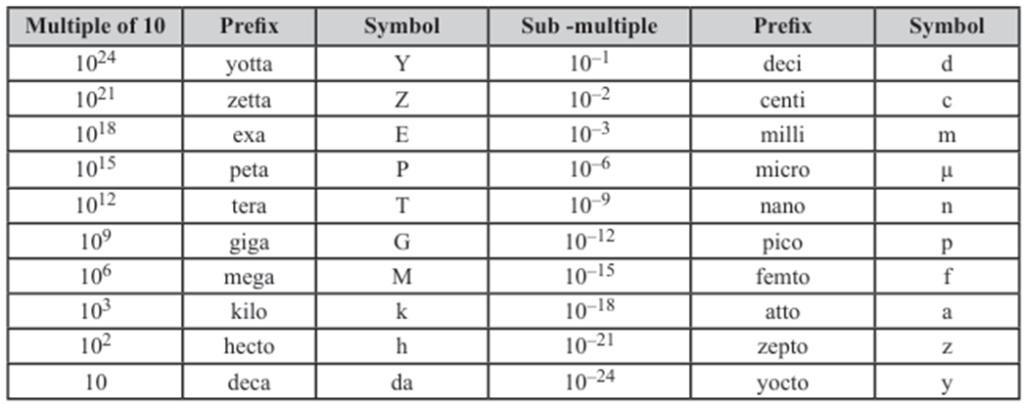
When a prefix is placed before the symbol of unit, the combined prefix and symbol should be considered as one new symbol which can be raised to a positive or negative power without any bracket, e.g., km3 means (103 m)3 but never 103 m3.
ERRORS IN MEASUREMENTS
Generally measured value of a quantity is different from the true value of the physical quantity. The difference between the true value and measured value is called error. Error = true value – measured value Before we discuss about errors let us understand two important terms :
Accuracy : It is the measure of how close the measured value is to the true value of the physical quantity.
Precision : It tells us about the limit or resolution upto which the quantity is measured.
Types of Errors
Systematic errors :
Those errors which tend to be in one direction, either positive or negative, generally their cause is known. These errors can be minimised by improving experimental techniques, selecting better equipment and removing personal bias. Some of the sources of systematic errors are:
(a) Instrumental errors: This type of error arises due to imperfect design or calibration of the measuring instrument. For example zero mark of vernier scale may not coincide with zero mark of main scale in a vernier callipers.
(b) Imperfection in experimental procedure: For example, measuring temperature of a human body by placing thermometer under armpit would give lower temperature than the actual body temperature, ignoring force of buoyancy during the measurement of weight of a body etc.
(c) Personal error: This type of error arise due to lack of proper setting of the apparatus, individual bias, or due to carelessness while taking observation. For example, if you hold your head towards right while reading ammeter or voltmeter there will be some error due to parallax
(d) Errors due to external factors like variation in temperature, humidity, pressure, wind etc. may introduce errors. For example wind may introduce error while taking the time period of a simple pendulum.
Random errors: These arise due to unpredictable and random variations in experimental conditions like temperature, voltage supply, personal error by observer etc. These errors are also called ‘chance’ errors as these occurs irregular and are random with respect to sign (negative or positive) and size. Random errors can be minimized by taking the observation several times and taking the arithmetic mean of all the observations.
Least count errors : The error associated with the resolution of an instrument is called least count error. By using instrument of high precision and improving experimental technique we can minimize least count errors.
Gross errors : These arise entirely due to carelessness of the observer like reading an instrument without proper setting, recording observation incorrectly etc. This type of errors can be minimised if the observer is mentally alert and sincere.
Absolute, Mean Absolute, Relative and Percentage Error
Absolute error : The magnitude of the difference between the true value and the individual measured value is called absolute error of the measurement.
Absolute error An = amean – an
It can be negative or positive or zero also.
Mean absolute error: It is the arithmetic mean of magnitudes of absolute errors in all measurements.
i.e., Mean absolute error,
Relative or fractional error: It is the ratio of mean absolute error to the mean (true) value of measured quantity.
It is unitless
Percentage error : If relative error is expressed in terms of percentage then it is called percentage error (δα).
Percentage error (δα) = relative error × 100
Final measurement in terms of the percentage error will be expressed as (αmean±δα%).